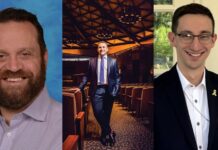
High Holiday sermons are some of the most important moments of the year for the Jewish community, as rabbis offer what they hope to be relevant messages to large crowds at Rosh Hashanah and Yom Kippur services.
Several area rabbis spoke to Baltimore Jewish Times about their sermons and the process leading up to the holiday season.

Rabbi Yerachmiel Shapiro, the spiritual leader of Moses Montefiore Anshe Emunah Hebrew Congregation, said that, for Rosh Hashanah, he’ll be speaking about the importance of the holiday in a time of rebirth and renewal.
He added that he wants to cover the renewal of an optimistic attitude toward ourselves, each other and the world at large, something that can fade during a long and difficult year.
“Over the course of the year, and it seems especially true now, we get jaded, desensitized and cynical. Rosh Hashanah is the rebirth of the world and a time of immense joy and hope. We wash away the burden of the past so we can fire on full cylinders launching into a new year,” Shapiro said.
Shapiro said that, for Yom Kippur, he plans to speak about forgiveness and break down what the concept means and how it works in real life.
Shapiro said that whether a person attends synagogue regularly or not, the High Holidays come with a heightened sense of importance. He said it’s a time of year when everyone is connecting with their spiritual selves, God and their ancestors.
Shapiro added that the importance placed on the holidays means that people are listening closely, and these sermons are his most developed and well-thought-out speeches of the year. The extra attendance doesn’t faze Shapiro either.
“I don’t find it hard to speak to everyone. Even though I’m speaking to 500 people, I’m really just speaking to myself and letting them listen. The secret is that I’m the one who needs fixing the most,” Shapiro said.

Rabbi Joshua Gruenberg, the senior rabbi at Chizuk Amuno Congregation, said that we’re now entering two years since Oct. 7, and that the world possibly feels more unsettled now than this time last year or even two years ago. Gruenberg approaches his High Holiday sermons by first reflecting on the desires of the congregation.
“Each year, for me, one of the things that I try to do is put myself in people’s positions. Like, I’m walking into the synagogue on the High Holidays this year, what am I looking to hear? And, of course, it’s a rabbi’s job to then differentiate between what people are looking to hear and what they might need to hear, because those are two extremely different things,” Gruenberg said.
Gruenberg added that combining what people need to hear and what they want to hear is always challenging, and he said it might be more difficult this year to do that, considering how the world is so “fraught.” But that’s the job of the rabbi.
“It’s less about how difficult it is and more about finding the right voice. As for the length of the process, it takes a long time, because even once you write, you edit and you tinker with each word and each line in each sentence,” Gruenberg said.
In the end, it’s the deadline that forces Gruenberg to figure out what he wants to say.
Otherwise, he said, “If you gave me time to edit a few words the morning of, I would probably do it.”
Gruenberg said that the never-ending process reflects that a rabbi knows the speech is important. He added that, when he speaks to “newly-minted rabbis,” one of the things he tells them is that people take rabbis seriously.
“I think that [holds true] all the time, and that, above all else, is what elongates the process,” Gruenberg said.
bhamelin@midatlanticmedia.com