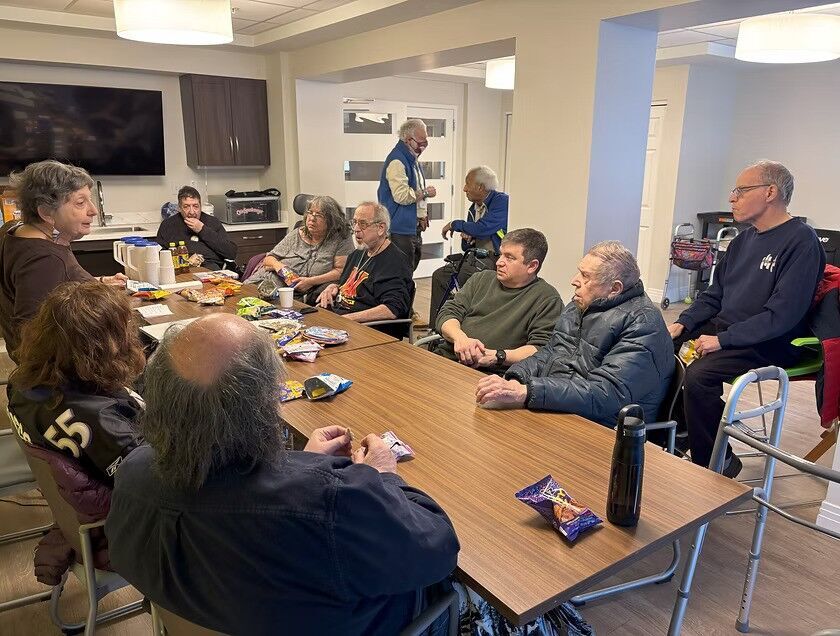
Much of Jewish communal life is rooted in tradition, but much is contemporary, as well. At the Baltimore Jewish Cultural Chavurah, even as the news gets increasingly polarizing and Israel and Zionism continue to be cultural flashpoints, members are not steering away from today’s news.
In fact, they’re addressing it head-on.
Take, for example, an event this year that discussed the differences between liberal Zionism and anti-Zionism — an important distinction that was inspired by a talk that member Fred Pincus, a sociologist and professor emeritus at University of Maryland, Baltimore County, heard.
“I brought it up with the planning committee. We don’t have a board of directors; we have a planning committee that anybody can join. And I suggested playing the video [of the talk] and then having a discussion afterwards, and people enthusiastically agreed,” Pincus said.
That discussion saw Chavurah members discuss the idea of supporting the existence of Israel while also advocating for better treatment of Palestinians, as opposed to the belief the Jewish state has no right to exist.
“I think anti-Zionists and liberal Zionists would agree a lot about the criticism of Netanyahu,” Pincus said. “But their solutions are different … there was some respectful discussion, which we’ve had in the past when Israel came up. We don’t have a position and we don’t always agree on things.”
BJCC President Art Starr said since Oct. 7, he is more of a Zionist than he was before. What he found at the event is most attendees differ on where to go from here, as Israel is at a pivotal point in the eyes of the international community.
“I think that the bigger issue, really, or the most divisive issue, probably as our members take it, is one-state solution versus two-state solution,” he said. “There was a lot of concern about the suffering that’s taking place in both Israel and in Gaza.”
For Starr, it’s important to distinguish between not supporting the current government of Israel and being anti-zionist.
“It’s coloring people’s views of Zionism,” he said.
Holding an event like this isn’t necessarily easy, even in a community with a tradition of respecting opposing views. Starr said when it comes to Israel and its future, it takes certain points of emphasis to make sure a conversation between people who may disagree goes well.
“It’s come up as a topic when we’ve had discussions about Israel in the past, before Oct. 7. We’ve always restricted it to members. We picked a strong person to be the facilitator. We have reminded people to be respectful and not engage in cross talk or divisive comments and character attacks,” he said.
It hasn’t always been that way for members outside of the BJCC. Starr said people have told him they’ve had fractured relationships over disagreements about Israel, with some saying friendships have ended.
At the BJCC, members like to live their Judaism through community contributions and cultural tradition. The organization was founded 2 1/2 decades ago as a Jewish community that places the emphasis on culture and not prayer.
For the members of the community, this and other programming — whether it be for holidays, at senior living communities or elsewhere — is about preserving the past.
“Most of [what we do] is just about the history and the culture of Judaism,” member Sonia Samuel said. “We just want to keep it alive because there’s so much great history out there … we just want to make sure that we’re sharing that information.”
While conversations that touch on delicate issues are limited to members, Starr said any member is welcome to share what they think — certain opinions aren’t excluded from the tent.
“I’m a great believer that you should honor people’s feelings, and that their feelings are just their feelings — neither right nor wrong, and they shouldn’t be attacked for expressing them,” Starr said.
aguckes@midatlanticmedia.com