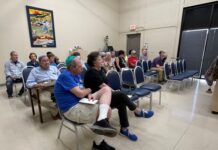
Shabbat services at Temple Beth Shalom in Annapolis usually draw a relatively modest crowd of around 40 to 50 people on an average weekend. But during the High Holidays, as many as 10 times that number of congregants descend upon the synagogue to observe Rosh Hashanah and Yom Kippur.
Many synagogues see a significant uptick in congregants attending services during the High Holidays. An article that appeared on the website The Conversation, which was written by David L. Graizbord, director of the University of Arizona’s Center for Jewish Studies, noted that for many members of the Jewish community, these holidays mark the only time that they attend a synagogue during the year.
Larger synagogues are well-equipped to handle such an influx in congregants, but for smaller congregations, accommodating hundreds more people than normal during High Holidays services can be challenging.
A survey of Jewish Americans by the Pew Research Center found that just one in five Jewish people in the U.S. attend services at least once a month. For the remaining four, High Holidays services might be the only service they attend all year.
“The High Holidays always promise higher numbers,” said Beth Shalom’s Rabbi Ari Goldstein. “The morning services have close to 500 people [attending], while the evening services are closer to 350 … thankfully, we can handle an increase in attendance without too much of an issue. Our space can handle the additional people.”
Obstacles like these often require more creative solutions, especially for synagogues with smaller sanctuaries. Some may be able to set up additional chairs and accommodate everyone who attends inside, but others have experimented with holding High Holidays services outside.
Kol Nefesh in Columbia, which operates out of the shared Oakland Mills Interfaith Center, has considerably less space than a typical synagogue. During the COVID-19 pandemic, they moved their services to their outdoor pavilion — a change that was so well-received that they still hold their Rosh Hashanah services outside four years later.
“We all loved davening in nature, so we’ve continued holding Rosh Hashanah morning services outdoors and brought Yom Kippur services back inside at the interfaith center,” explained Kol Nefesh’s Rabbi Stephanie Weishaar. “Unlike many congregations that require tickets to participate in High Holidays, Kol Nefesh services have always been open to the community. … With today’s safety concerns, we just ask folks to let us know in advance that they’ll be joining us.”
Additionally, Kol Nefesh kicks off the High Holiday season in an unconventional way: instead of a traditional Selichot service, they hold a “Selichot and Sundaes” ice cream social at Color Burst Park.
Adat Chaim in Owings Mills has dealt with the problem of accommodating so many people in a small space by bringing their High Holidays services into the modern age. Their services are simultaneously live-streamed via Zoom, which allows family members of congregants and congregants who may be out of town for the holidays to attend and daven in the comfort of their own home.
They also reach out to individual members, both ones who attend in person and ones who will be joining on Zoom, to participate directly in the service by chanting or reading specific passages. That way, people can have an active hand in the service even if they are unable to attend in person.
Adat Chaim also welcomed a new rabbi shortly before the start of the High Holidays season, which poses some additional challenges, as one of the first services he orchestrates at Adat Chaim will be one of their biggest and most demanding.
“We recently hired Rabbi Ilan Glazer as our part-time rabbi, and he begins officially on Sept. 1,” said Cathy Litofsky, Adat Chaim’s president. “This in itself poses some challenges as we transition to a new rabbi. The Board and Ritual Committee are working together with Rabbi Ilan to provide a most meaningful and spiritual High Holiday season and beyond.”
Finally, small Orthodox synagogues face an obstacle specific to them during the High Holidays: accommodating more women than usual. Congregation Ohel Torah in Pikesville will soon be moving into a new space, which will help them with this issue, but it’s something they have to consider in their current building.
“At a typical Shabbat service, we get a very small amount of women outside of special occasions,” said Ohel Torah President Avi Yudkowsky. “So it’s about accommodating and trying to provide a good experience for the women who are coming, and who want to daven as well.”
The synagogue, which opened its doors in 2021, has largely dealt with this by creating a seating plan based on the amount of congregants signing up to attend services.
“We operate a bit more ad hoc, based on the feedback we get from attendees … we try to figure out the best way to light up the room, so to speak,” Yudkowsky added.
jdiamond@midatlanticmedia.com