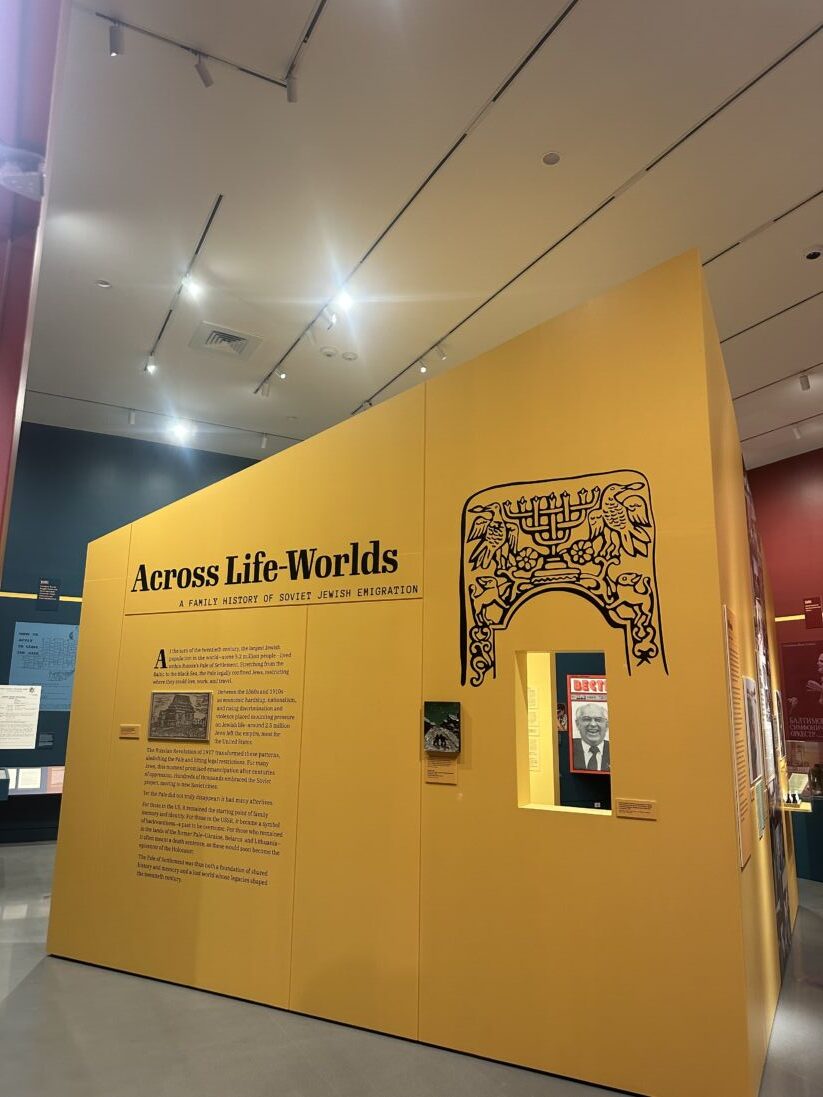
About a year and a half ago, Jewish Museum of Maryland Executive Director Sol Davis contacted Vlad Smolkin and requested he curate a new exhibit at the museum.
Smolkin, who owns an art gallery in Baltimore and is the child of Soviet Jewish immigrants, was a natural choice to contribute visual components to the new exhibit, titled “Across Life-Worlds: A Family History of Soviet Jewish Emigration.”
The museum would be able to provide most of the history from the American perspective, but that’s not the whole story, Smolkin said.
“What it was kind of missing was the story from the Soviet side and first-person experiences of the families that went through this movement,” he said.
As they moved forward, they realized there was another missing piece in assembling a comprehensive team.
“At that point, it became clear to me that as an artist and art curator and gallerist, I didn’t have the full expertise to tell the story in its entirety,” he said.
Smolkin knew the perfect person: his sister, Victoria Smolkin.
“She’s a Soviet historian and a professor of and a scholar of this history,” he said. “I proposed this to Sol, and he thought it was a great idea.”

A joint venture was born: Vlad Smolkin, Victoria Smolkin and the Jewish Museum of Maryland.
The exhibit’s opening event was held Sunday. The culmination of months of hard work by the team was special for the Smolkins because the exhibit is so deeply personal. Taking special care to do justice to the stories that make up “Across Life-Worlds” was essential to the Smolkins.

“We were really conscious and mindful of the way that we curated the show and the way we structured the show to really create the space for different experiences and different perspectives,” Victoria Smolkin said.
There are three components to the exhibit, she said. The Soviet Jewish aspect, the American Jewish aspect and the immigrant experience.
“And what we try to do in telling these chronologies is [tell them] kind of parallel, but also in conversation with each other, is to make these communities realize both what is common and shared across their experience, but also what is distinct and what they can learn about the experience of the other,” Victoria Smolkin said.
A key way the Soviet Jewish experience and journey to America is explored is through the symbolism of the two suitcases families who were emigrating from the Soviet Union were allowed to take with them.
“This idea of two suitcases is a kind of running metaphor, because each family that emigrated were allowed to bring two suitcases per person, and so there’s this question of what do you bring when you have so little real estate and you know you’re never coming back,” Vlad Smolkin said. “So a big part of the show is talking about the kinds of objects people brought in these two suitcases.”
One of the exhibit’s stories plays out like a Hollywood film. The Baltimore Symphony Orchestra played in the Soviet Union in the late 1980s. One of the members of the orchestra was a Soviet Jew.

“One of the brothers had emigrated 10 years earlier to Baltimore and was actually a part of the Baltimore Symphony Orchestra, so he’d come back 10 years later as part of the symphony and was met by his brother. We have the news stories, both from the American side and the Soviet side, of this tour of the Baltimore Symphony. But then we have the oral history of the brother that was physically there, that is in many ways contradictory to the news stories on both sides,” Vlad Smolkin said.
For Vlad Smolkin, a process that took more than a year to put together is the beginning of something great, not the end. The exhibit runs through next spring, and he and Victoria hope those who attend continue thinking about the issues the exhibit raises moving forward.
“One of the goals of the show was not to ‘other’ each other, [we wanted] to ask this question about what is the greater Jewish family, and there was a palpable sense of that in the room, which was very gratifying,” he said. “The goal for us is not to see the exhibition as an ending to something, but actually as a beginning to a conversation. I think that that really started to happen [Sunday], just talking to people in the exhibition and how people felt they saw themselves in this exhibition from both sides.”
aguckes@midatlanticmedia.com