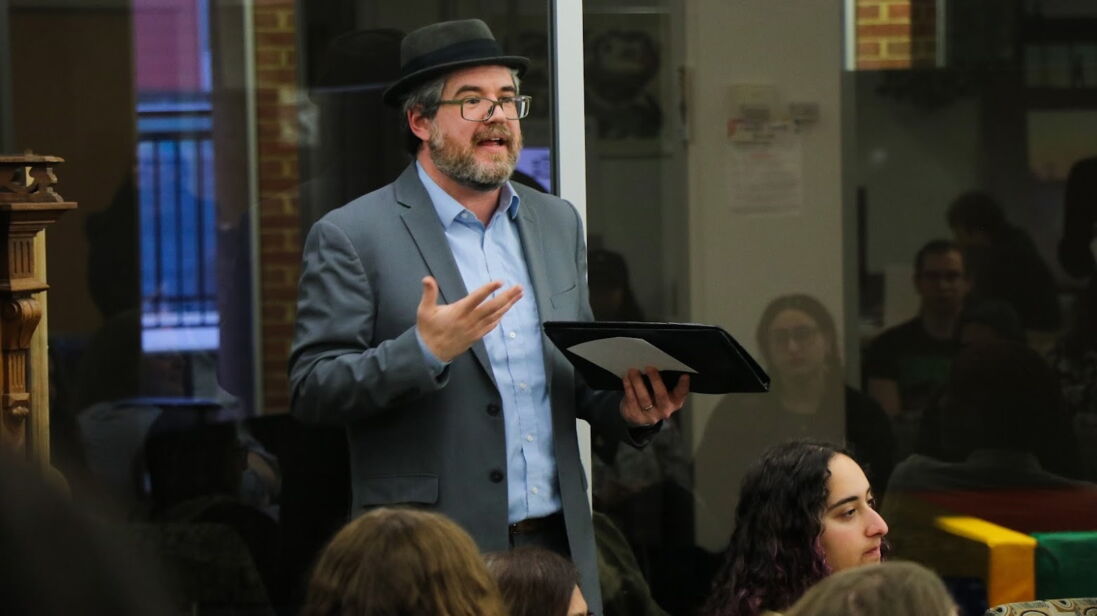
Rabbi Alex Salzberg, 40, did not always want to be a rabbi.
Salzberg grew up in Owings Mills attending Chizuk Amuno Congregation, attending school at Krieger Schechter Day School until eighth grade, then going into Pikesville High School, for what Salzberg calls “a very classic Baltimore Jewish story.”
But he wasn’t thinking about a career as a clergyman during those years. It wasn’t until he was 30 that he graduated rabbinical school. He is now in his fourth year as the rabbi for Towson University Hillel. He lives in Reservoir Hill and belongs to Beth Am Synagogue.
What made you want to become a rabbi?
This was a decision I came to late in college. I was thinking I was going to work for the government in some capacity, and my wife actually at one point suggested that I might enjoy being a rabbi as well. I thought that might be an interesting second career, and then when I was a senior in college, I led my university’s Birthright trip to Israel, and there was something just really powerful about the experience of helping my peers engage with Judaism in a way that they hadn’t before, and talking through their questions and their ideas and their thoughts — it was just so much more compelling to me than anything I could imagine doing with the government. I came home, I got off the plane, and I immediately called the Director of Admissions at [Jewish Theological Seminary] and asked if it was too late to apply.
What made you want to become a rabbi for Hillel?
That I came to also very, very late, after I was ordained. Before I actually went to JTS, I got my master’s at Towson as part of the inaugural class of the Baltimore Hebrew Institute, as they made the transition from being the Baltimore Hebrew University to being a part of Towson University. So, I got my master’s degree there, after college, before going up to JTS. I deferred for three years and then after I was ordained.
I was a pulpit rabbi for six years in Westchester, New York, and there were parts of that that I really loved and parts of that that I really didn’t. So, when it came time to decide what to do — one of my contracts was expiring— I decided not to render the contract. I wanted to come home to Baltimore, but I also knew that I didn’t want to be in the pulpit anymore. I was reflecting on what were the parts of that work that were really meaningful to me and the two pieces that really spoke to me the most were the relationship building, being a part of people’s lives and the education. So, when I came back to Baltimore, I taught for one year at Krieger Schechter, which was amazing. It was fantastic to teach at the school that had educated me. And then this opportunity came up. I realized that it fit both of those boxes perfectly. It was all about relationships. It was all about education. It’s all about building community, which is the essence of what I see my [job] being about.
What is your favorite part of your job?
I think my favorite part of my job is building a new connection, whether that’s between a student and the community, the Hillel and another organization of the community on campus. We do an incredible amount of interfaith work that was actually just recognized by Hillel International. We just received Hillel’s Innovation Award for our multi-faith art show that we put together last year. Building that connection was really powerful.
Also [assisting] students and what comes next, helping them to decide where they’re going to go, as far as the first job, or what their community is going to look like when they graduate. Building those connections has always been something that I gravitate towards.
What would you say is the hardest part of your job as a Hillel Rabbi?
I was at Hillel through Oct. 7 and for the years following that. But in some ways, those were the most powerful moments of helping our students stay connected and stay safe and feel comfortable on campus. They definitely weren’t easy, but they were important enough and relevant and powerful enough in the moments that I wouldn’t actually call them the hardest part. They were challenging, but not something that I would think is like, ‘Oh, I can’t believe I have to do this again.’