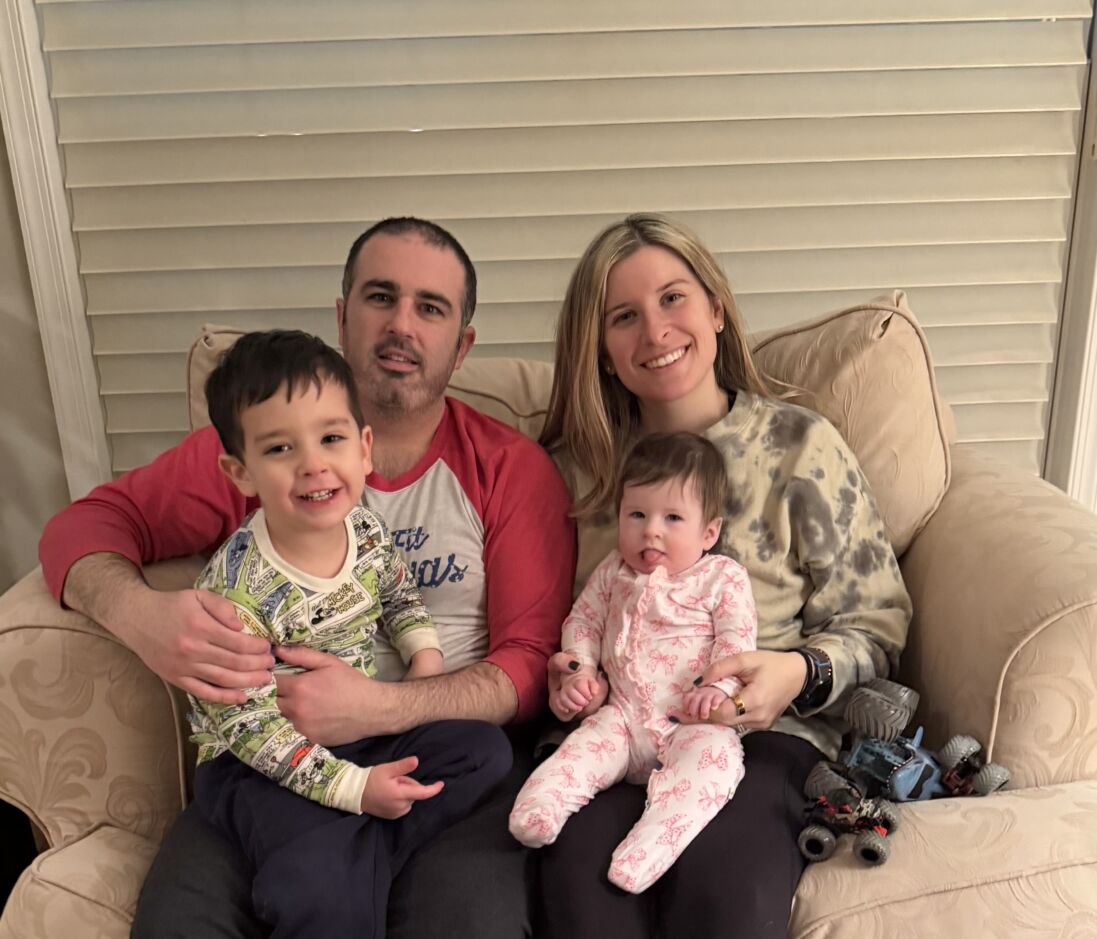
Jake and Jen Lieberman appear to be your average Jewish American family: dad, mom, a 3-year-old son, a 10-month-old daughter and a dog. What isn’t visible to the eye is that their daughter lives with a rare genetic disorder, and the Baltimore parents are entrenched in advocacy on her behalf, guided by Jewish values.
“As Jewish people, we believe in showing up for one another,” Jen Lieberman said.
When her daughter, Addison, was born in March 2025, the Reisterstown resident said she felt that something wasn’t right.
“The doctors [and] nurses were all chalking it up to [her] just being a preemie and extra sleepy,” Jen Lieberman said. “I had a feeling in my ‘mom gut’ that there was something else going on.”
She researched what that “something” could be, and came across Prader-Willi Syndrome, a rare genetic disorder that results in low muscle tone, feeding difficulties and other physical, mental and behavioral problems. “I was like, ‘This is what Addison has,’” Lieberman said. Her doctors disagreed.
Jake and Jen Lieberman pushed for genetic testing. A week and a half later, the Liebermans discovered that their daughter had PWS. They connected with parent support groups.
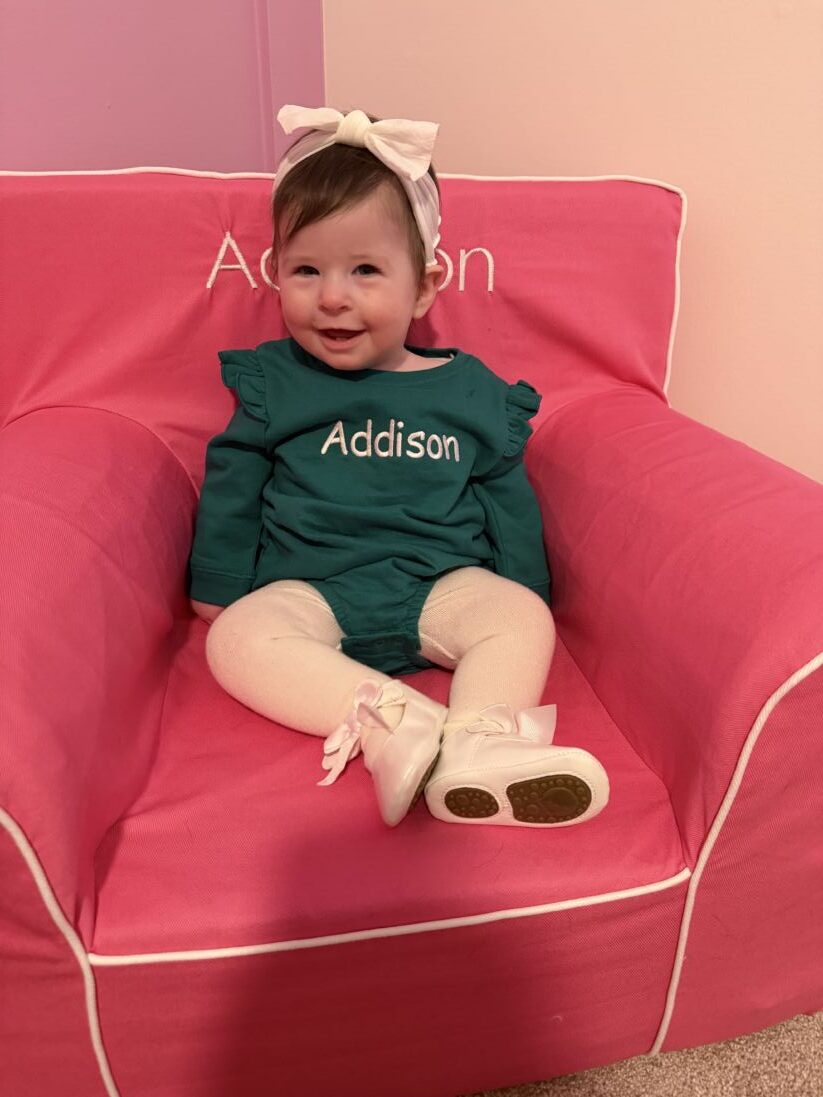
“At first, we weren’t as public about it while we were in the NICU, but by the time we got home, I posted [online],” Jen Lieberman said. “I wanted to share with the world that this is Addison. She has Prader-Willi Syndrome. She is a fighter. Since then, I have been in full advocacy mode.”
The Liebermans connected with the Foundation for Prader-Willi Research. “Raising money and being involved is so important to us,” Jen Lieberman said.
She learned that the Foundation hosts a charity walk, One Small Step, in locations across the United States, but that there wasn’t one in Maryland. So, the Liebermans are bringing it to Baltimore. The walk, which entirely benefits PWS research, is scheduled for May 2 at Reisterstown Regional Park. About 100 participants have registered so far at the time of publication.
The Foundation’s research primarily focuses on treating the aspects of PWS. Jen Lieberman spoke to the advancements made possible by funding and research.
“One of the crippling things about PWS is around a certain age, … children develop something called hyperphagia, where they never feel full,” she explained. “There have been children who [feel like they’re] constantly starving, where families have to lock up the pantries, cabinets and trash cans.”
Children with PWS most commonly develop this insatiable hunger sometime during childhood, with the average age of onset at about 8. Hyperphagia often leads to excessive overeating, a lack of satiety and a preoccupation with food, which can cause obesity. In March 2025, the FDA approved the first treatment for hyperphagia, according to FPWR.
“That is all because of the research and the organizations,” Jen Lieberman said.
Jake Lieberman volunteers as a PWS community advocate reviewer for FPWR, a role in which he reviews proposed research projects “in the eye of the public” to ensure that they’re relevant to PWS families.
Jen Lieberman said the upcoming community walk currently occupies a lot of her advocacy around PWS. On social media, she regularly educates about life with PWS, expanding what the Liebermans call Addison’s Army.
“The other day, I posted Addison in her physical therapy session trying to get in the crawling formation,” Jen Lieberman said. “I explain she takes medication called growth hormones. Studies have shown that growth hormones really help with development and muscle tone.”
The mom of two also “constantly” contacts companies and brands — potential sponsors — to educate them about PWS and ask if they will participate or donate to One Small Step Maryland.
“Jen is on the computer probably till about 11 o’clock every night emailing companies,” Jake Lieberman said. “We have a sponsor from a kids’ furniture company in Australia, so that’s how far Jen has reached.”
Jen Lieberman puts in these hours after her day job as a teacher because she said PWS is a condition that “nobody knows about.” During Addison’s 60-day stay in the NICU, some doctors and nurses said that they had studied PWS in textbooks, but never seen anyone living with it in real life.
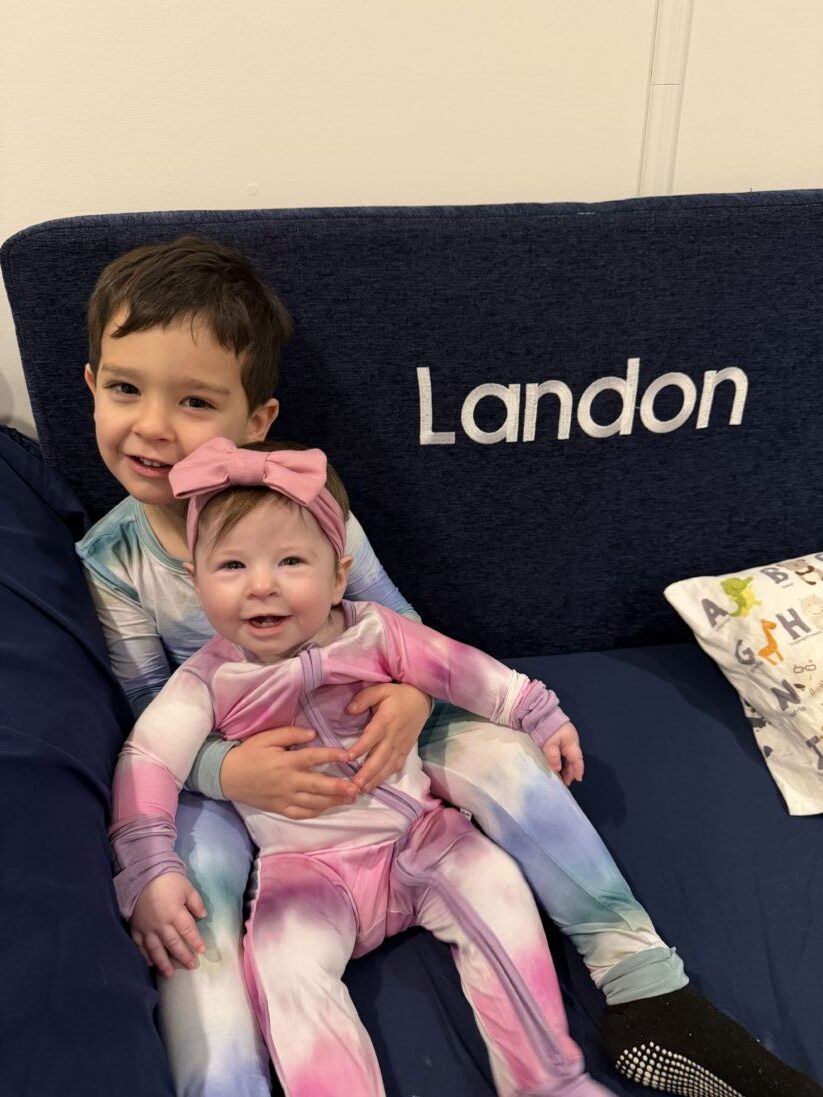
Strangers commented that Addison was “such a chill baby” because she didn’t cry, not knowing that infants with PWS do not cry often or loudly due to their low muscle tone.
“I want the world to know about it. There’s just not enough understanding,” Jen Lieberman said. “Not only are we advocating for Addison; we’re advocating for families all over [the] United States and the world.”
This work expands on the couple’s community service from before they had children.
“We are very philanthropic people,” Jake Lieberman said, pointing to his former active involvement with The Associated: Jewish Federation of Greater Baltimore.
He and Jen Lieberman founded The Associated’s Couples Committee. Jen Lieberman, a Baltimore native and lifelong community volunteer, has served on several Associated committees. Their advocacy connects to the Liebermans’ Jewish values.
“Jake and I both have strong Jewish roots,” Jen Lieberman said. “We grew up learning about acts of service, tzedakah, giving back to the community. … Those are just our values.”
“We just want to spread as much awareness as possible,” said Jake Lieberman.
Only one in 20,000 people lives with PWS, while one in 200 has Down syndrome.
“If you think about the amount of patients and affected people out there, it’s very small in comparison to other syndromes. So, I think it’s even more vital to be outspoken about it because there’s a limited number of voices,” he said.
“This is so rare,” Jen Lieberman said. “Through it, I’ve met the most amazing families, and I just think it’s important that the world knows.”
She said she remains hopeful thanks to Addison’s therapists and medical team, as well as scientific advancements. “I truly have hope,” Jen Lieberman said. “But it can’t just be me having the hope. Everyone has to have the hope.”